This diary is written by a journalist from Mon State who is seeking refuge in Mae Sot, Thailand. They are receiving support from The Kite Tales to write these diaries.
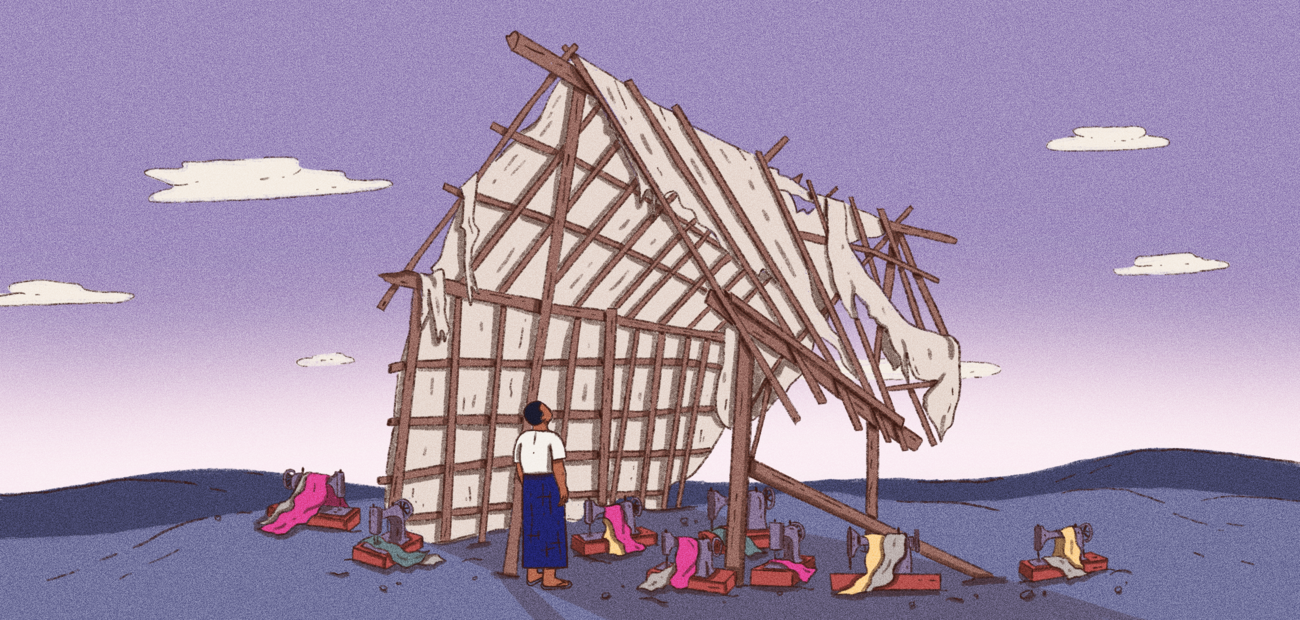
Exhaustion was clearly written on Ko Chit’s face as he let out a long sigh. He was working 8am to 10pm at a small garment workshop in the Mae Pa neighborhood of Mae Sot, Thailand and taking home barely enough to survive.
Ko Chit arrived in Mae Sot in March 2024, crossing the border to evade the Myanmar military’s conscription drive. Since the coup in 2021, thousands of Myanmar citizens opposing the junta have entered border towns like Mae Sot—both legally and illegally—seeking safety. Following the conscription law in February 2024, even more young people in the 18 to 35 age range for military service have fled to Mae Sot.
Finding employment has become increasingly difficult. Worse still, since the majority of Myanmar nationals enter illegally and live as undocumented residents, they are vulnerable to wage exploitation by Thai employers. Even when they know they are being exploited, their undocumented status leaves them facing situations where they cannot report these grievances in any way.
Without a Work Permit, Ko Chit was unable to find a job for several months after arriving in Mae Sot. He survived on the savings he brought from Myanmar, but as time passed, his funds nearly ran out.
While searching for job postings online, he found an advertisement seeking workers for a small garment business. Grasping at straws, he went to inquire, hoping to secure a job. The recruiter told him: "Even without experience, we will teach you how to sew. But you have to pay a training fee. Afterward, you can work right here at this garment shop."
Ko Chit recalls with a laugh that he was so happy to find out he could get a job despite being undocumented that he even cried. When he started work and asked about wages, the recruiter explained that since he was a trainee, there was no fixed salary yet, but his pay would increase based on his proficiency.
Since two trainees were needed, Ko Chit brought along a friend who was also unemployed. The two of them had to borrow money with interest to pay the training fees. Upon arriving at the garment workshop, the employer informed them that accommodation would be provided for free, but they would have to cover their own food costs.
Knowing he had no money left for rent, Ko Chit was overjoyed to hear he would have a place to stay. He even happily fantasized about sending money back to his parents once he started earning a salary after the training period.
Excluding lunch and dinner breaks, the workday amounted to 12 hours. Ko Chit said they had to sew parts for children’s clothes and women’s trousers, producing thousands of pieces within a month.
"For children's shirts, we had to sew on decorative elephant figures. For trousers, we had to sew the waistbands where the elastic goes. We sewed decorative ribbons. Once we finished our parts, there was someone else specifically assigned to assemble the pieces into finished garments," he said.
Despite working hard for the entire month, when payday arrived, all his hopes were dashed - like pouring water into sand - and he was left demoralized. Ko Chit received only 723 baht for a month's work, while his friend received only 500 baht. The minimum daily wage officially set by the Thai government for migrant workers ranges between 337 and 400 baht. Based on Ko Chit’s monthly salary of 723 baht, his daily wage was only about 24 baht. That is an amount that cannot even buy a cup of coffee in Thailand. However, because they are undocumented immigrants, they cannot report the employer for wage exploitation.
When they asked other workers about their wages, they discovered that even the labor leader who had posted the job ad and taught them sewing only earned 1,600 baht. Furthermore, the most skilled worker in the factory earned only 2,000 baht.
When contacted, workers currently employed there refused to be interviewed on the record due to security concerns.
"We can't go back," one said.
"In Myanmar, everything is being devastated by civil war. We don't have money to get legal documents. That’s why we just accept working like indentured servants in exchange for food, saying 'as long as we have a place to stay, that’s enough'."
The artwork is by JC who is receiving support from The Kite Tales to produce illustrations.