The author is a journalist from Yangon who was jailed for reporting on the military’s abuses after the 2021. They received support from The Kite Tales to write these diaries.
“Daung… Daung… Daung…”
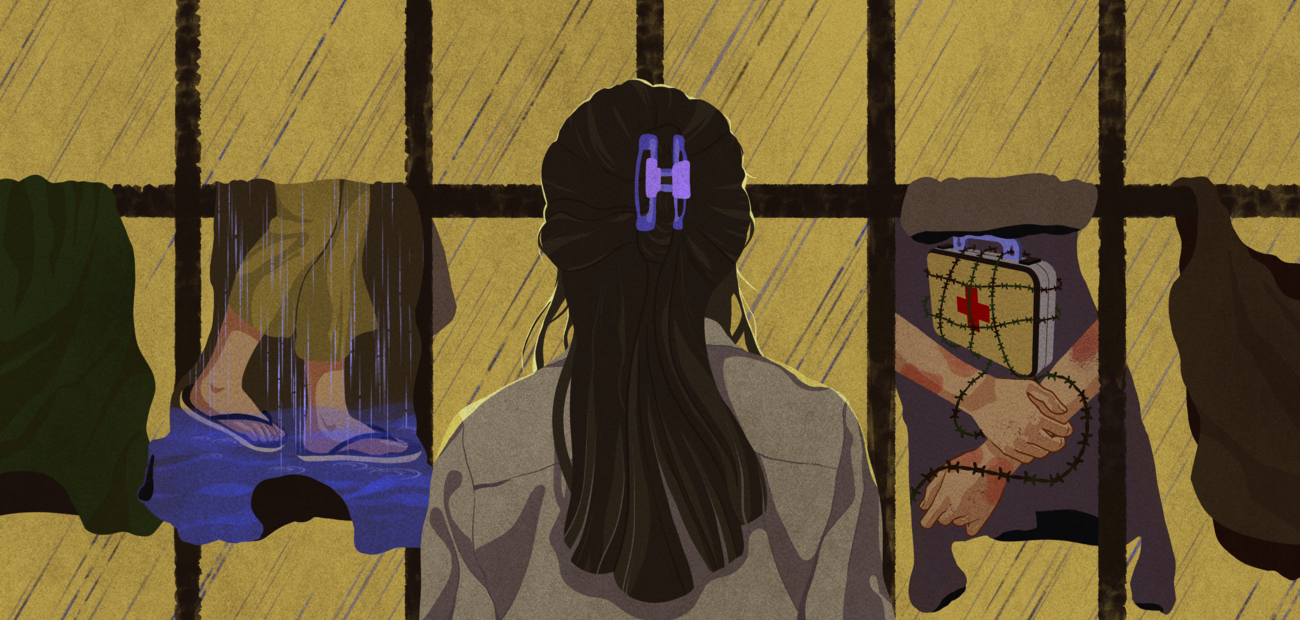
At every cell door, women stood ready, their arms piled high with wet clothes. The moment they heard the iron rod strike, it was as if a starting pistol had been fired. Pushing, shoving, and shouting, they scrambled past each other to get outside first, the noise of their struggle echoing through both the upper and lower floors.
This frantic morning rush was a daily routine during the rainy season in Women's Ward #3 of Insein Prison, starting just after 7 a.m., when the doors of the prisoners' buildings were unlocked.
Why were they running like this? Why was this task so urgent? Any woman who has been an inmate in that ward would know.
The women's wards at Insein Prison were always over-crowded. In the rainy season, the daily task of drying clothes became a major problem. The prison's official clotheslines were never enough, so inmates would rush out at unlock time to hang their clothes, only to have to run back and snatch them off the lines each time it started to rain again.
It was even worse when it rained suddenly between 11 a.m. and 2 p.m., during lock-up. When that happens, the inmates had to wait for the warden's permission to go outside and retrieve their clothes. If the warden was late in giving permission or the door key was delayed, the half-dry clothes would become completely soaked again.
I couldn't run like the others, so I tried to wear only thin, quick-drying clothes. I would wash them early in the morning and hang them outside just long enough for the excess water to drain off before lock-up. Then I would hang them on the iron bars at the head of my bed.
By the time the evening lock-up came, my clothes were only slightly damp. If I draped them over the small pack of my belongings at the foot of my bed, they would be dry enough to wear by morning. I survived two rainy seasons with this improvised method.
"Looking at us living amidst these damp clothes, you'd think we were living in a laundry barracks," some of the inmates would say, groaning in frustration.
For anatomical reasons, wet clothing is even more dangerous for women, who are at greater risk of certain infections. Both men and women would often develop skin rashes, ringworm, head lice and eczema.Due to a lack of sufficient medical care, inmates suffering from contagious skin diseases often had no choice but to simply endure .
Besides this problem, we women inmates faced many other challenges during the rainy season. The prison buildings were constructed with large, open iron bars and window frames that had no outer doors, so anyone could look inside from anywhere. At night, when it rained, the water would splash in through the iron bars and windows. The inmates sleeping near the windows would have to spend the entire night huddled together in a dry spot in the corner.
There were also times when other inmates were kept up all night because of leaky roofs. During the day, they could move to another area, but at night, after lock-up, they were strictly forbidden to move from their designated sleeping area.
During my time in the remand ward, I had a comfortable spot during the rainy season. But after I was moved to the convicted ward, my bed was right next to a window. After the first heavy rain, I asked the warden for a clear plastic sheet to cover the area, which helped a lot.
Even so, the plastic sheet didn't offer complete protection. I had to roll it up when it wasn't raining and unroll it when it did, so I had to work hard to keep the rainwater from leaking in at the edges. During my time in the convicted ward, I often prayed that it wouldn't rain at night.
Another hardship we faced during the rainy season was flooding. Although the water didn't reach the sleeping barracks, the outdoor walkways would be completely submerged. We had to walk back and forth through the stagnant water to get food, wash dishes, and do laundry.
When we had to go to the prison hospital or appear in court, we would have to walk through the rain holding a long plastic tarp over our heads with four or five other inmates. This helped during a mild drizzle, but if it rained heavily, we would get soaked from the head down, except for our hair. We couldn’t dry off until we returned to the ward, which could take hours. Needless to say, this was another significant cause of illness at the time.
I would try to stay put in my spot during the rainy season, like I was anchored. I'm someone who likes to be safe, warm, and cozy in a rain-proof house during the rainy season, so being in prison during the rain was a frustrating experience for me. The damp, soggy conditions would make me feel listless and gloomy. During those times, I would try my best to read a book or force myself to sleep.
Therefore, for political prisoners confined in Myanmar's prisons, where human rights are absent, the prison is not just a hell by day and a hell by night. It is a place of double hell, where the hardships of the seasons are added to their suffering.
The artwork is by JC who is receiving support from The Kite Tales to produce illustrations.